
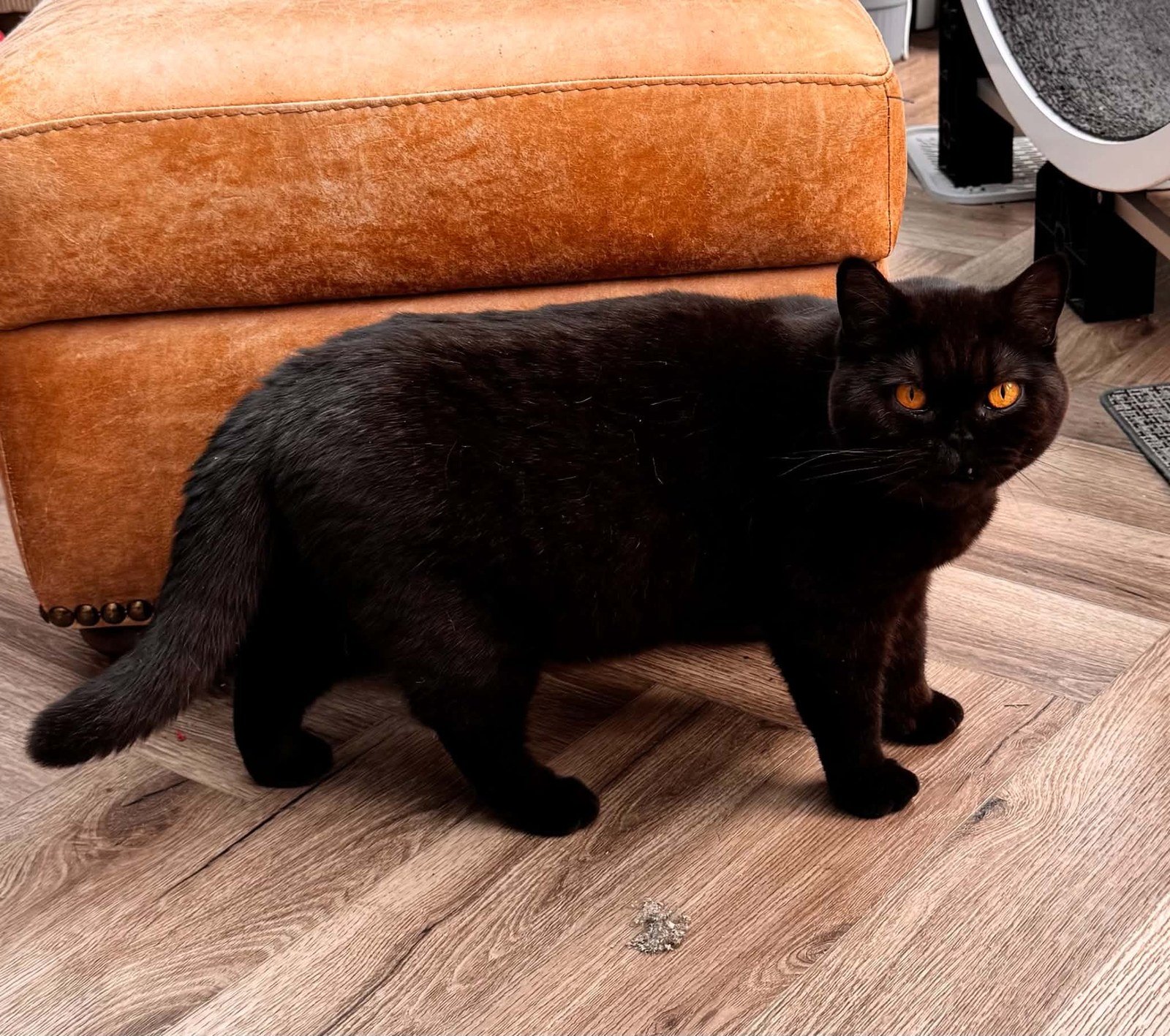
People often ask me what I am actually doing when I have a British Shorthair on my judging table at a show. From the aisle it looks like a quick once-over — a bit of handling, a stroke, a few lines written on a slip. In fact a judge is reading the cat against the breed standard, point by point. You do not need to be planning to show your cat to find this interesting — understanding what a good British Shorthair should look like helps you appreciate the breed, and helps you spot quality when you are choosing a kitten.
On this page
- What I see before I touch the cat
- It is won and lost on the head
- The coat should push back
- Why a beautiful cat can still lose on colour
- Temperament on the table
- How show judging actually works
- What costs a British Shorthair points
- What I’ve learned at the judging table
- Why this matters when you are choosing a kitten
- Frequently asked questions
This is the show-bench view. For the everyday picture of the breed — its personality and its many colours. I go into more detail on The British Shorthair Cat, the breed site I write.
What I see before I touch the cat
Before I touch the cat I take in the whole picture. A British Shorthair should look compact, powerful and well balanced — what the standard calls ‘cobby’. It is a cat of substance, with a broad chest, short strong legs and a thick tail with a rounded tip. Nothing should look exaggerated or weak. The first impression should be of a sturdy, dignified cat that is comfortable in its own skin.
It is won and lost on the head

The head is one of the breed’s defining features. I am looking for a round, broad skull set on a short, thick neck, full cheeks (especially developed in mature males), a short broad nose with a gentle dip, and small, well-rounded ears set wide apart. The eyes should be large, round and set well apart, with a colour appropriate to the coat. It is that round, open face that gives the British Shorthair its famous teddy-bear expression.
The coat should push back
The coat is unmistakable when it is right. It should be short, dense and ‘crisp’ — standing slightly away from the body rather than lying flat, with a plush, firm feel under the hand. A soft, woolly or sparse coat is a fault. When I run my hand over a good British Shorthair coat, it springs back. Texture matters as much as colour.
Why a beautiful cat can still lose on colour
The British Shorthair comes in a wonderful range of colours and patterns, each with its own standard for coat colour, eye colour and (where relevant) pattern. The classic British Blue is the best known, but black, white, cream, the colourpoints, tabbies, tortoiseshells and the rarer cinnamon, fawn and golden are all recognised. On the bench, colour and pattern are judged against the specific standard for that variety — a beautiful cat in the wrong eye colour for its coat still loses points.
Temperament on the table
Finally, temperament, and for me this is not a footnote. What I want to see is that placid, laid-back British Shorthair temperament when a cat is on my judging table at a show. Not a cat that merely tolerates me, but one that stands there unbothered while a stranger runs their hands over it, in a hall full of noise and several hundred other cats.
I judged a cinnamon boy called Maverick twice inside a fortnight at the end of last year: once at the Chinchilla, Silver Tabby & Smoke, and again a fortnight later at the National. Large, solid, cobby, the sort of cat who takes up the whole trolley. Then he opened his mouth, and out came the squeakiest little voice you have ever heard from a cat that size. (I put it in his critique. It was the first thing about him I wanted to remember.)
Both times he stood there and let a stranger go over his head, his coat and his bones, in a hall full of noise and several hundred other cats, and never made a fuss about any of it.
That is the breed doing exactly what it should.
He is GrCh HENBRITS TOPGUN MAVERICK, and he is the sire of Rosie’s first litter — why we chose him is on our queens page.
Paula stewards for me at shows, and she will tell you she can spot the good-tempered ones before the pen is even open, from the way they sit in her arms as she carries them across.
The breed is not a lap-sitting, demanding cat (it is steady, undemanding and quietly affectionate) and a cat that handles like that on my table is showing you the same character you will get on your sofa at home.
How show judging actually works
At a GCCF show the cats are penned, and the judge comes to each cat in turn at a trolley, handling and assessing it against the written Standard of Points for its breed and colour. Every breed has a points breakdown (so many points for head and type, so many for coat, so many for colour and condition) adding up to a hundred. The judge writes a report on each cat and places them in order. It is not a beauty contest in the loose sense; it is a measured comparison of each cat against the ideal described in its standard, not against the cat in the next pen.
What costs a British Shorthair points
Knowing the faults is as useful to a buyer as knowing the virtues. Common ones I see on the table include a coat that is too soft or too long, a head that lacks the breadth and roundness the breed calls for, eyes that are the wrong colour for the coat, a body that is racy rather than cobby, and condition issues — a cat carrying too much weight, or out of coat. None of these make a cat a poor pet, but they are the difference between a typey show cat and a pet-quality one, and they are worth understanding when a breeder explains why one kitten is destined for the show bench and another for the sofa.
What I’ve learned at the judging table
Standards and points tell you what a British Shorthair should be. Years of handling them teach you the rest.
- Type is set young, but condition is the owner’s gift. The best-bred cat can look ordinary out of coat and underexercised; an averagely-bred cat in glorious condition can shine. How a cat is kept shows on the table.
- Temperament is part of quality. A cat that handles sweetly is showing the very character that makes the breed such a good companion. I have no time for the idea that a show cat can be excused bad temper.
- The famous round face is harder to breed than it looks. Keeping breadth of head and good eye shape, generation after generation, is the quiet work that separates the serious breeders.
- A judge is really assessing a breeder’s decisions. When I admire a cat on the table, I am admiring years of careful pairings behind it, which is exactly what a buyer is paying for too.
Our own Rosie is the everyday version of that last point. She is not a cat on a mission. She is a black girl who follows Paula from room to room and lies flat out on the leather pouffe with her paws stuck out in front of her, but she has the same steady, unbothered nature I look for on the table, and she has handed it straight on to her kittens. That is the part of breeding I care most about.
Why this matters when you are choosing a kitten
You may never set foot at a cat show, and that is fine, but understanding what a judge rewards helps you choose a better kitten. When a breeder tells you a kitten has “good type” or “a lovely head”, you now know what they mean and can see it for yourself: the round, broad face, the dense crisp coat, the cobby little body, the calm temperament. It also tells you something about the breeder. A breeder who shows their cats is having their breeding decisions judged in public, against the standard, by people like me, which is a powerful incentive to breed typey, healthy, good-natured cats rather than just produce kittens. So when you choose a kitten from show lines, you are not paying for rosettes; you are buying the years of careful pairing that the show bench quietly enforces.
Free download — no sign-up needed
Print it out and take it with you. New to the breed? Our Kitten Buyer’s Checklist helps you spot quality.
More free guides: Diet & Feeding Sheet · Weight & Growth Tracker
Frequently asked questions
What does “cobby” mean for a British Shorthair?
Cobby describes the breed’s compact, sturdy, well-balanced build (broad chest, short strong legs, rounded body) as opposed to a long, lean type.
What makes a British Shorthair’s coat correct?
Short, dense and crisp, standing slightly away from the body with a firm, plush feel that springs back under the hand. Soft or woolly coats are a fault.
Do judges only care about looks?
No. Temperament matters. A British Shorthair should handle calmly and good-naturedly on the table — the same steady character that makes it a fine family cat.
Does colour affect judging?
Yes. Each colour and pattern is judged against its own standard for coat and eye colour, so the cat must match the standard for its specific variety.
Should I show my pet British Shorthair?
If your cat is GCCF registered, showing can be enjoyable and a good way to meet other enthusiasts. Even pet cats can be shown in the appropriate classes — ask your breeder.
You do not need to be showing anything to use this. Next time you look at a litter, run your hand over the coat and feel for the density, look at the width between the ears, and see whether the kitten minds being handled at all. That last one tells you more than the rest put together. My guide to choosing a kitten takes it further.