
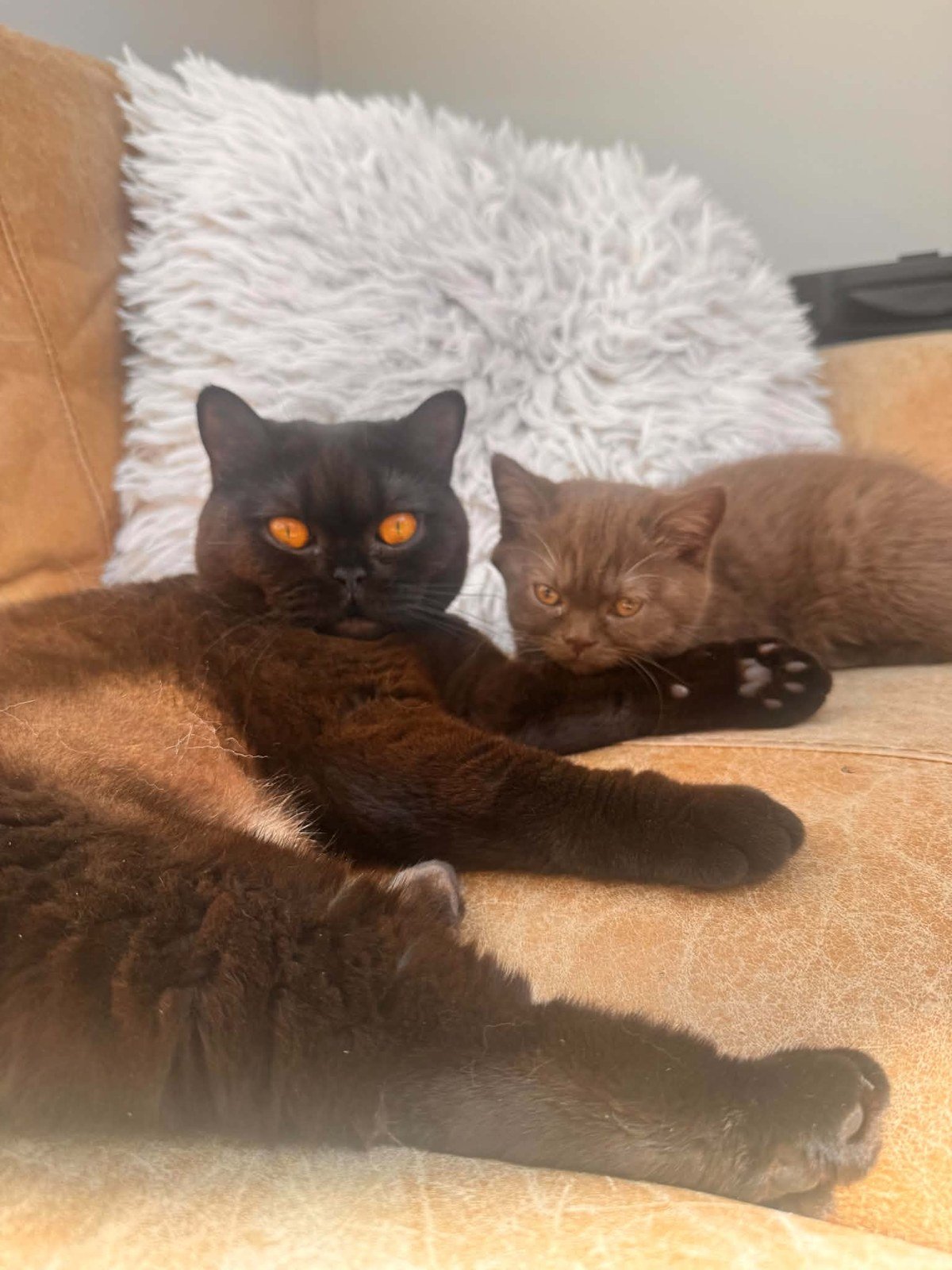
The British Shorthair’s popularity has a downside: it is one of the most scammed and most carelessly bred cats in the country. As a GCCF judge I see both ends of it — the lovely cats that come from careful breeders, and the poorly bred or fraudulently sold kittens whose owners come up to me at a show and ask what went wrong. So rather than write another list of warning signs, I have done something I have not seen another breeder do. I have turned the questions on myself, and answered them the way I would want a breeder to answer me.
On this page
If you are at the very start and still researching the breed itself, the buying a British Shorthair guide on the breed site I write covers the basics. This article is about vetting the breeder.
The questions I would ask if I were buying a kitten from me
Advice is cheap when it costs the person giving it nothing. Anybody can publish a list of things a good breeder does and quietly leave themselves off it. So here are the nine questions I would put to a British Shorthair breeder if I were the buyer, with our own answers underneath, including the two where the honest answer is not the flattering one.
1. How long have you been breeding British Shorthairs?
Not long at all. EzBritz is a new prefix and Rosie’s May 2026 litter is our first British Shorthair litter. If you are looking for a BSH breeder with twenty years of the breed behind them, that is not us yet, and you should know that before you go any further.
What we do have is more than twenty years of breeding and showing pedigree cats. Paula and I started in 2004 under the Burnthwaites prefix for Siamese and Orientals, and everything that carries over — queening, rearing, socialising, the paperwork, knowing when a kitten is off colour before it looks it — carries over completely. The breed is new to us. The job is not. You are entitled to weigh that up however you like.
2. Why did you use this particular stud?
This is the question I would push hardest on, because a breeder who cannot answer it is breeding from whoever was available.
We used GrCh HENBRITS TOPGUN MAVERICK, and I had judged him myself long before we considered him — I have set out what that means on our queens page. The point for you is this: I am not repeating somebody else’s opinion of that cat. I formed my own, on the record.
A breeder does not need a judging licence to answer this well. They need a reason. “He is local” and “he was free” are reasons too — just not good ones.
3. What have you tested for, and what have you not tested for?
The second half of that question is the one that gets you a real answer, and it is where I would expect a breeder to squirm slightly. Here is ours.
Both parents are PKD1 tested clear at Langford Vets, so the kittens are clear by parentage. Both were blood typed before the mating, because type B occurs in this breed and a mismatch is a problem you plan around rather than discover.
We do not heart scan. Plenty of British Shorthair breeders advertise that they do, and I could put it on this website tomorrow and look better for it. I have set out honestly why we don’t, quoting the GCCF’s own breeding policy, and I would rather you read that and disagree with me than take a claim on trust. Be equally sceptical of anyone selling you an “HCM DNA tested” British Shorthair.
4. Can I see the mother, in the room the kittens were raised in?
Yes, and if any breeder says no to this, stop there. Nothing else on this page matters more.
Our cats are pets first. They live in the house with us, not in a cattery block, with a secure catio and no free roaming, and the kittens grow up underfoot among other cats and ordinary household noise. That is not a selling point so much as the whole method: a kitten that has already met a vacuum cleaner and a doorbell is a kitten that copes with yours.
5. What is the price, and what does it include?
£1,200, with a £300 deposit to reserve. It is published on this site, on the kitten information page, and in the first reply I send anybody.
Only a minority of British Shorthair breeders publish a price at all, and I think that is a mistake — a price you have to ask for is a price that can move. If a breeder will not tell you the number until they have decided how keen you are, that is worth noticing. I have itemised where the £1,200 goes, down to what Langford charge per test.
6. How old will the kitten be when it leaves?
Fourteen to sixteen weeks. Thirteen is the GCCF minimum and we do not treat a minimum as a target — a kitten needs its full vaccination course finished and then a couple of weeks to settle before it goes anywhere.
Watch how a breeder talks about this. “Ready at eight weeks” is not a breeder. “Thirteen weeks, no exceptions” is a breeder following the rule. A breeder who keeps them longer than they have to, and can tell you why, is one who has thought about it.
7. What happens after I take the kitten home?
You get me, for the life of the cat. I am always here to help with anything, and I mean that literally rather than as a line on a website.
Ring us. At week three when the kitten has not eaten since lunchtime, at month seven when it starts doing something you have never seen a cat do, at year nine when you are weighing up a decision with your vet and want to talk it through with somebody who knows the breed. I am a certified feline behaviourist as well as a judge, so the behaviour questions are not a nuisance. They are the part I enjoy most. We would always rather you rang us early than worried alone.
One thing I would say to any buyer, about any breeder: be clear in your own mind about the difference between support and insurance. Support is somebody who knows the breed answering the phone for the next fifteen years. It is not a financial safety net, and no breeder’s goodwill is a substitute for having the cat properly insured from the day it arrives, which is why every kitten leaves here with four weeks’ free Petplan cover, to give you time to arrange your own before it runs out.
And if things go wrong at our end: an emergency out-of-hours caesarean now runs from £800 to £1,400, and I have been through one. What that night cost, and what it cost besides money, is in my article on what a British Shorthair actually costs. I mention it because “what happens if something goes wrong” is a question about money as much as intentions, and you are entitled to know whether a breeder can find that sum at two in the morning without pausing.
8. What will you say no to?
A breeder with no conditions is a breeder with no standards. Ours, plainly:
- Indoor only. It is a condition of our contract, not a preference.
- Collection from us in Fareham, Hampshire. We do not deliver and we do not meet halfway. You come here, you meet the mother, you see where the kitten grew up. that is the point of it.
- Non-active registration. Kittens go on the non-active register as a matter of course. Active registration is considered for established breeders by prior agreement, and not otherwise.
And we will say no to people. I would rather disappoint a lovely family who are out of the house twelve hours a day than place a kitten that will spend its life alone. If a breeder has never turned anyone down, ask yourself what they are selecting for.
9. What are you going to ask me?
This is the one buyers never think to ask, and it is the most revealing of the lot. A breeder who wants to know about your hours, your other pets, your children’s ages and what happened to your last cat is a breeder placing kittens. A breeder who wants to know only whether the money has cleared is doing something else. You are allowed to find the interrogation reassuring.
The green flags of a responsible breeder
Generalising outwards from the above, a breeder worth buying from will tick most or all of these, and will be glad you asked:
- Registers their kittens with the GCCF, and happy to tell you their prefix.
- Health tests their breeding cats (for British Shorthairs that means PKD1 and blood typing at minimum) and will show you the certificates rather than describe them.
- Can tell you what they have not tested for, and why. An honest gap is worth more than a vague claim.
- Lets you visit and see the kitten with its mother, in the home where it was raised.
- Asks you questions about your home, work pattern and other pets.
- Has a waiting list and is in no rush to sell.
- Provides a contract and a kitten pack.
- Offers genuine lifetime support — somebody who is still there to help in year nine, not just until the money clears.
The red flags that should stop you

Any one of these is a reason to walk away, and several together almost always mean a scam or a kitten farm:
- Will only communicate by message and avoids a phone or video call.
- Pushes for a deposit before you have seen the kitten and its mother together, in the home.
- Cannot or will not show you the mother cat.
- Offers to meet you in a car park or deliver the kitten to your door.
- Has kittens of several different breeds available at once, all year round.
- Prices that are suspiciously low, or oddly, suspiciously high with pressure to pay fast.
- No health testing, no paperwork, no questions for you.
How to check a breeder is genuine
A few minutes of checking saves a great deal of heartache:
- Reverse image search the kitten photos — scammers reuse the same images across many adverts.
- Ask for the GCCF prefix and check it is real.
- Insist on a video call with the kitten and its mother together, in the home.
- Never pay by bank transfer or gift cards to someone you have not met; use a method with buyer protection for the deposit.
- Be wary of anyone who creates urgency — a good breeder wants the right home, not a fast sale.
You can also start from a vetted directory rather than an open marketplace. The British Shorthair breeder listings are a sensible place to begin. The same principles apply to any pedigree breed, incidentally. I have written the Siamese version of this over on CattyLicious, and the tells are identical.
Why this matters more than price
A scam costs you money; a badly bred kitten can cost you years of vet bills and heartbreak. Kittens from careless breeding are more likely to carry inherited disease, to be poorly socialised, and to struggle in a family home. The few hundred pounds you might ‘save’ on a cheap kitten is nothing against the cost (financial and emotional) of getting it wrong. Choose the breeder first, and the right kitten follows.
If you want to see how we answer our own questions, British Shorthair kittens for sale at EzBritz in Hampshire sets out our kitten list, our price and what we ask of a buyer.
What a kitten farm or scam looks like in practice
It helps to picture the two things you are trying to avoid, because they look different. A scam is usually a person who has no kitten at all — stolen photos, a convincing story, and pressure to send a deposit fast. A kitten farm is worse in a way: there is a real kitten, but it has been bred for profit with no health testing, weaned too early, and raised without socialisation, often alongside several other breeds.
The tells overlap. With a scam, the photos turn up on other adverts, the seller dodges a video call, and the price is either too low or oddly high with urgency attached. With a kitten farm, you are offered a kitten quickly, at eight or ten weeks, with no pedigree, no health tests, and a meeting somewhere other than the home. In both cases the common thread is simple: you are never allowed to see the kitten with its mother, in the place it was raised.
What I’ve learned in the cat fancy
I judge cats at GCCF shows and I have reared plenty of my own. Here is what I would tell a friend buying their first British Shorthair.
- The boring breeders are the best breeders. The ones who bombard you with questions, make you wait, and send a three-page care sheet are exactly the ones you want. Slick and easy is a warning sign, not a convenience.
- Scammers exploit excitement. Every buyer I have known who got stung was rushing — a birthday deadline, a child desperate for a kitten. Slow the process down and most scams fall apart on their own.
- A real breeder is relieved when you ask hard questions. It tells us you will be a careful owner. The buyers who ask nothing are the ones who worry me.
- Photos prove nothing; the mother proves everything. I have lost count of the lovely ‘kitten’ photos that turned out to be lifted from a cattery in another country. Insist on seeing mum, live.
- Ask a breeder what they are not good at. It is the hardest question to fake, and the answer tells you whether you are talking to someone honest. Ours is on this page, twice.
- If your gut says something is off, it is off. In more than twenty years I have never heard anyone say ‘I wish I had ignored my doubts and sent the money anyway’.
Free download — no sign-up needed
Print it out and take it with you. Take our Kitten Buyer’s Checklist with you so nothing gets missed.
More free guides: Diet & Feeding Sheet · Weight & Growth Tracker
Frequently asked questions
Should I pay a deposit before seeing the kitten?
Not until you have verified the breeder is real and the kittens exist. Get the terms in writing before you send anything — what the deposit reserves, what happens if the breeder withdraws a kitten on health grounds, and what happens if you change your mind. Ours is £300, non-refundable if you change your mind and refunded in full if we withdraw a kitten. A breeder who will not put that in writing is telling you something.
Is a GCCF prefix proof a breeder is responsible?
It is a strong positive sign (it means they are registered and accountable) but still check health testing and that you can visit. Registration plus health testing plus a home visit together is the gold standard.
Why are some British Shorthair kittens so cheap?
A low price usually means no health testing, early weaning, or a scam. Responsible breeding is expensive to do properly, and the price reflects that.
What paperwork should come with the kitten?
A GCCF pedigree and registration, vaccination record, a contract, and a kitten care pack. Missing paperwork is a red flag.
If you are about to send a deposit to somebody and something feels off, stop and ask. Ask me, if there is nobody else to ask. I have no interest in whose kitten you end up with, and none at all in watching you lose £300 to a photograph. The contact page has my number on it.