
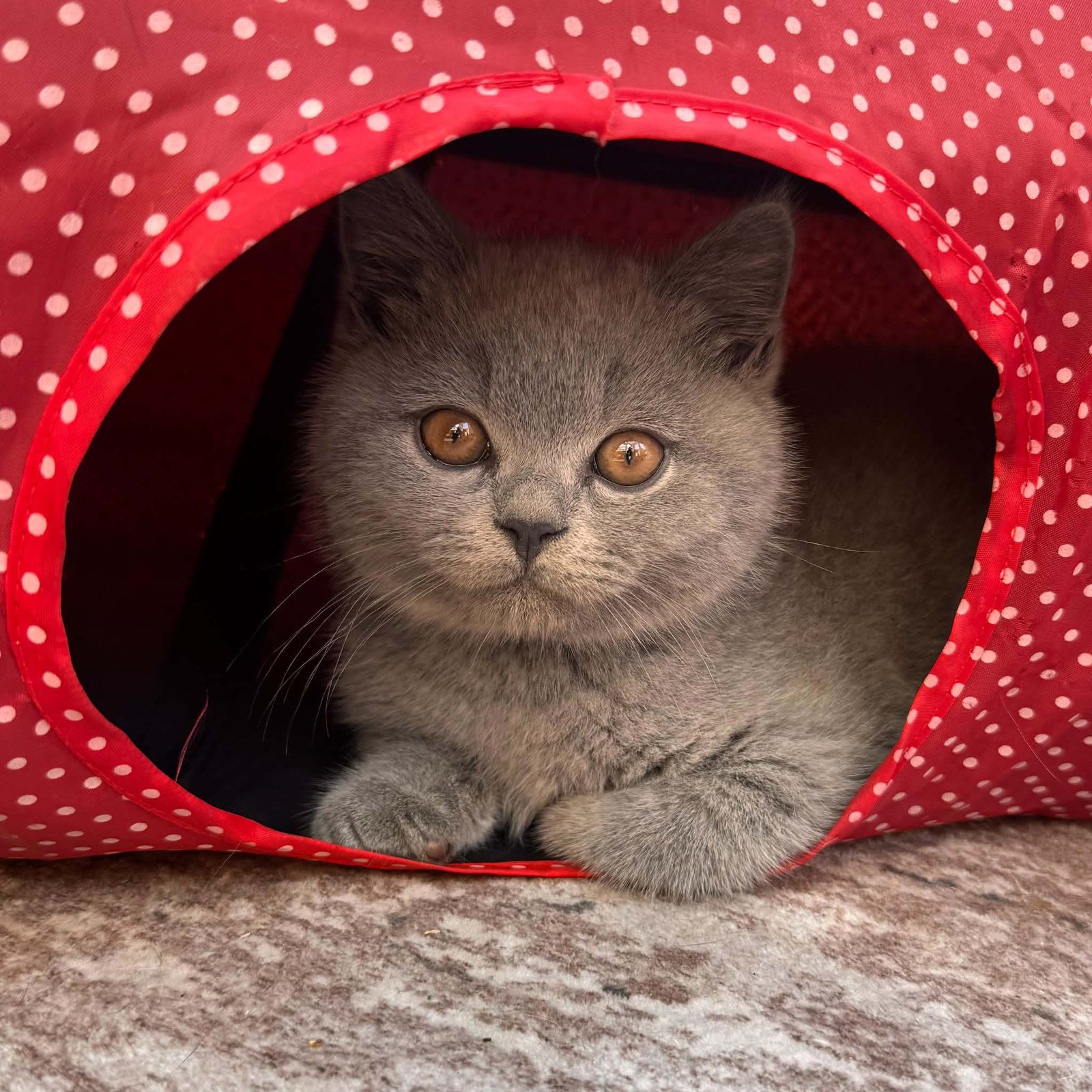
I judge British Shorthairs on the show bench. I have also bred and shown Siamese and Orientals for more than two decades. I have also sat on the other side of the table — as the person a nervous family is trusting to sell them the right kitten. Choosing a British Shorthair kitten is one of the loveliest decisions you will make, but it is also one where a little inside knowledge saves a great deal of heartache. This is the guide I wish every buyer had before they picked up the phone.
How I chose which kitten to keep
It is easier to explain what to look for if I show you a real decision, so here is the one I made this year.
Keeping a daughter from Rosie was always the plan. That is the part people tend to miss about a well-planned litter — the breeder is usually breeding for themselves first, and the kittens that go to pet homes are the ones from a pairing that was made for a reason.
The reason, in this case, was the boy. I had admired GrCh HENBRITS TOPGUN MAVERICK long before he came anywhere near one of our girls, and I had judged him myself — the full story of why we chose him is on our queens page.
So the mating was not a hopeful guess. It was a queen I know inside out, put to a boy whose type I had already examined with my hands and written up on a report sheet, with both parents PKD1 tested clear and blood typed before anything happened.
Then the kittens arrived and I got lucky, which is the part no amount of planning controls. Highway has genuinely good type — the breadth of head, the round open expression and the coat texture the breed standard asks for, and she has the most wonderful temperament with it. That combination is not something you can order.
And then the unscientific bit, which I will admit to because every breeder knows it is true: she has stolen a piece of my heart. I could not part with her. Type and temperament made her the right cat to keep for the programme; the rest of it made the decision easy.
What that means for you as a buyer
Two things worth taking from it.
First, ask the breeder why they made this particular pairing, and whether they are keeping anything from it. A breeder who chose the stud for reasons they can explain (and who wants a kitten from the litter themselves) is telling you a great deal about the quality of what is left. A breeder who cannot answer, or who is keeping nothing, is telling you something too.
Second, do not be disheartened that the breeder keeps one. The kitten I kept is not better than her brothers and sisters as a companion. She is the one whose type suits where I want to take the breeding. The temperament that made her hard to part with runs right through the litter, because it comes from Rosie and from the way they were raised, not from luck.
On this page
If you are still deciding whether the breed is right for you at all, the breed site I write, The British Shorthair Cat covers the breed in depth — temperament, colours and how it compares to other breeds. This guide assumes you have set your heart on a British Shorthair and now want to choose a good one, from a good breeder.
Start with the breeder, not the kitten
The single most important choice you make is not which kitten. It is which breeder. A well-bred, well-reared kitten from a careful breeder will be healthier, calmer and better socialised than the prettiest kitten from a careless one. As a judge, the cats that walk onto my table relaxed and confident almost always come from breeders who do the unglamorous work behind the scenes: health testing, careful pairings, and raising kittens underfoot in a busy home.
Look for a breeder with a GCCF prefix who registers every litter with the GCCF, who health tests their breeding cats, who shows or is otherwise active in the cat fancy, and who is in no hurry to sell you a kitten. A good breeder will ask you as many questions as you ask them. That is a green flag, not an inconvenience.
Since I have just told you to interrogate the breeder, it would be a bit rich not to answer the awkward one about us. EzBritz is a new prefix, and Rosie’s May 2026 litter is our first British Shorthair litter. If you want a breeder with twenty years of this breed behind them, that is not us yet, and you should know it before you read another word of my advice.
What we do have is more than twenty years of breeding and showing pedigree cats under the Burnthwaites prefix, and a judge’s eye for this breed standard in particular. The breed is new to us. The job is not. I put the other eight questions to myself here, including the ones I would rather not have been asked.
What a GCCF judge looks for in a healthy kitten

When you visit a litter, you are not judging to a breed standard. You are looking for health and temperament. Here is what I check, and what you should too:
- Clear eyes and a clean nose — no discharge, no crusting, no sneezing in the room.
- Clean ears — no dark debris or head-shaking, which can indicate mites.
- A rounded, not bloated, tummy, and a clean rear end (a sign of good gut health and litter hygiene).
- A glossy, dense coat — the British Shorthair coat should feel plush and crisp, never greasy or sparse.
- Confident movement — kittens should be steady on their feet, curious, and happy to play.
- Sociable, not frantic — a good kitten will approach you or settle near you. Bold is fine; trembling and hiding is a worry.
Do not be seduced purely by markings or a fashionable colour. A sound, friendly kitten in a plain coat will make a far better companion than a stunning one that is nervous or unwell. For what the colours actually are and how they are described, the British Shorthair colours guide is the place to look.
Health testing: the questions that matter
This is where good breeders separate themselves, and where I would urge you to be politely firm. Ask the breeder which health tests the parents have had. For British Shorthairs the ones to know about are:
- PKD (Polycystic Kidney Disease) — DNA testing should show the breeding cats are negative or bred so kittens cannot be affected. Both of Rosie’s kittens’ parents are PKD1 tested clear, so the kittens are clear by parentage.
- Blood type — type B occurs in British Shorthairs, and a careful breeder plans matings with blood type in mind to avoid problems in newborn kittens. Ours are typed before the mating, not after.
- HCM (Hypertrophic Cardiomyopathy) — ask, but weigh the answer rather than the claim. Some breeders heart scan; we do not, and I set out honestly why on our health page. What matters is that a breeder can explain their position either way.
You can read the detail behind each of these on the British Shorthair health guide. The point for you as a buyer is simple: a breeder who tests will tell you about it gladly, and a breeder who has decided against a test will tell you why. A breeder who waves the question away is telling you something too.
What a well-reared kitten should come with
A kitten from a responsible breeder should never leave before 13 weeks. That is the GCCF minimum, and it exists because those last few weeks with mum and littermates shape a confident adult. Treat it as a floor and not a target: ours go home at fourteen to sixteen weeks. When your kitten does come home, it should arrive with:
- A full GCCF pedigree and registration.
- Two vaccinations and at least two vet health checks.
- A microchip (a legal requirement in England since June 2024).
- Worming and flea treatment up to date.
- A few weeks of free insurance to cover the settling-in period — ours go with four weeks’ Petplan cover.
- A kitten pack — food, a scented blanket, a diet sheet and care notes.
- A breeder who is at the end of the phone for the life of the cat.
If a kitten is offered to you at eight or ten weeks, unvaccinated, with no paperwork, walk away — however tempting the price. There is a fuller checklist of what to expect over on the buying a British Shorthair guide, and a practical list of what to have ready at home on CattyLicious.
A note on price, and on scams
A well-bred, health-tested, GCCF-registered British Shorthair kitten is not cheap, and it should not be. The cost reflects health testing, stud fees, quality food, vaccinations, microchipping and the breeder’s time. Ours are £1,200 with a £300 deposit, and I have itemised where that goes. If a price looks too good to be true, it usually is, and sadly the British Shorthair’s popularity makes it a target for scams. Be wary of breeders who will only communicate by message, who push for a deposit before you have seen the kitten with its mother, or whose photos appear on several different listings. A genuine breeder will always let you see the kitten with mum, in the home where it was raised.
Reserving the right kitten
Good kittens are often reserved before they are ready to leave, so do not be surprised to join a waiting list. That is a sign of a breeder worth waiting for. A sensible process looks like this: an honest chat about your home and what you are looking for, a visit by appointment once the kittens are old enough, a deposit to reserve, photo updates as your kitten grows, and collection once the kitten is ready. Take your time. The right kitten is one you will still be glad of in fifteen years, so a few weeks’ wait is nothing.
What I’ve learned choosing kittens
The textbook checks above will keep you safe. From the breeding side and the judging side, here is what I would add quietly, breeder to buyer.
- The calm kitten is usually the right kitten. Over the years the boldest kitten in the litter is not always the best pet — the steady, curious one that comes back to you after a fright tends to settle fastest in a new home.
- Watch the mother, not just the kittens. A relaxed, friendly queen raises relaxed, friendly kittens. If mum is fearful or you are not allowed to meet her, that tells you more than any photo of the kitten.
- A good breeder will sometimes say no to you. I would rather disappoint a lovely family who works twelve-hour days than place a kitten that will be alone too much. If a breeder never turns anyone away, ask yourself why.
- Trust the breeder who is still answering the phone two years later. The sale is the start of the relationship, not the end. The breeders I respect most are the ones whose kitten-buyers still send photos at Christmas.
- Don’t rush the colour. I have watched buyers wait months for a specific rare colour and end up with a beautiful cat they barely bonded with, while the family who took the steady blue boy got the cat of their lives. Temperament outlives novelty.
Free download — no sign-up needed
Print it out and take it with you. Our British Shorthair Kitten Buyer’s Checklist covers the breeder, the kitten and the paperwork.
More free guides: Diet & Feeding Sheet · Weight & Growth Tracker
Frequently asked questions
What age should a British Shorthair kitten be when it leaves the breeder?
No earlier than 13 weeks. That is the GCCF minimum, not a target. Ours leave at fourteen to sixteen weeks, by which point the kitten is fully vaccinated, weaned and properly socialised.
Should I choose a kitten on colour?
Health and temperament first, colour second. A sound, friendly kitten makes a wonderful companion whatever its coat. Choose the kitten, not the colour.
Is it normal to go on a waiting list?
Yes. Responsible breeders have small numbers of kittens and place them carefully, so a waiting list is common and a good sign.
If you are working through this with a breeder and something does not add up, stop and ask somebody. Ask me, if you like. I would far rather spend twenty minutes on the phone with you than watch you buy badly, and it costs you nothing. You can meet Rosie and see how ours are raised, or look at who is available now.