

Somebody rings and asks when the kittens will be ready. I say fourteen to sixteen weeks. There is a pause, and then nearly always the same question: why so long, when the litter advertised down the road is going at eight?
Here is the honest answer, including the part that does not flatter me. Keeping a litter another six weeks costs me money, costs us sleep, and means you wait longer than you want to. I do it anyway. By the end of this you will know exactly why, and what to ask a breeder who tells you eight weeks is fine.
On this page
- Eight weeks is a number borrowed from somewhere else
- What a kitten learns between eight and fourteen weeks
- The vaccination maths that settles it on its own
- It costs me money to keep them, and that is rather the point
- The things that only show up late
- Thirteen weeks is a floor, not a target
- What to ask a breeder who says eight weeks
- What the wait buys you on collection day
- Frequently asked questions
Eight weeks is a number borrowed from somewhere else
Ask most people how old a kitten should be when it comes home and they will say eight weeks. Ask where the number came from and the answer thins out considerably.
Eight weeks is the figure attached to puppies, and it has drifted sideways into cats the way these things do — something everybody half-remembers from a different animal. For pedigree cats it has no standing at all. The GCCF minimum is thirteen weeks, and a breeder who registers a litter with the GCCF agrees to that when they do it. (I am a GCCF judge, so I am hardly a neutral witness here. But the rule is public and you can read it yourself in the GCCF kitten agreement.)
An eight-week kitten is not a small cat. It is a baby that has only just finished weaning and has not yet learned most of what makes a cat easy to live with.
What a kitten learns between eight and fourteen weeks
This is the part I care about most, and I would care about it even if I were not selling you anything.
Those six weeks are when the social wiring gets done. A kitten learns bite inhibition from its littermates, because they tell it immediately and honestly in a way no human hand ever can. It learns to be told off by its mother and to recover from it without falling apart. It learns that the hoover is not a predator, the doorbell means nothing, and hands are for good things.
Take a kitten out of that at eight weeks and you do not get a blank slate. You get a kitten finishing its education alone, in a house with no other cats to correct it. Plenty turn out fine. The ones that do not are the ones biting too hard at eighteen months and getting called unpredictable, when what actually happened is that nobody ever taught them where the line was.
I am certified in feline behaviour and in cat anxiety and stress, and I will say plainly that a great many of the difficult adult cats I am asked about started as kittens who left home too early.
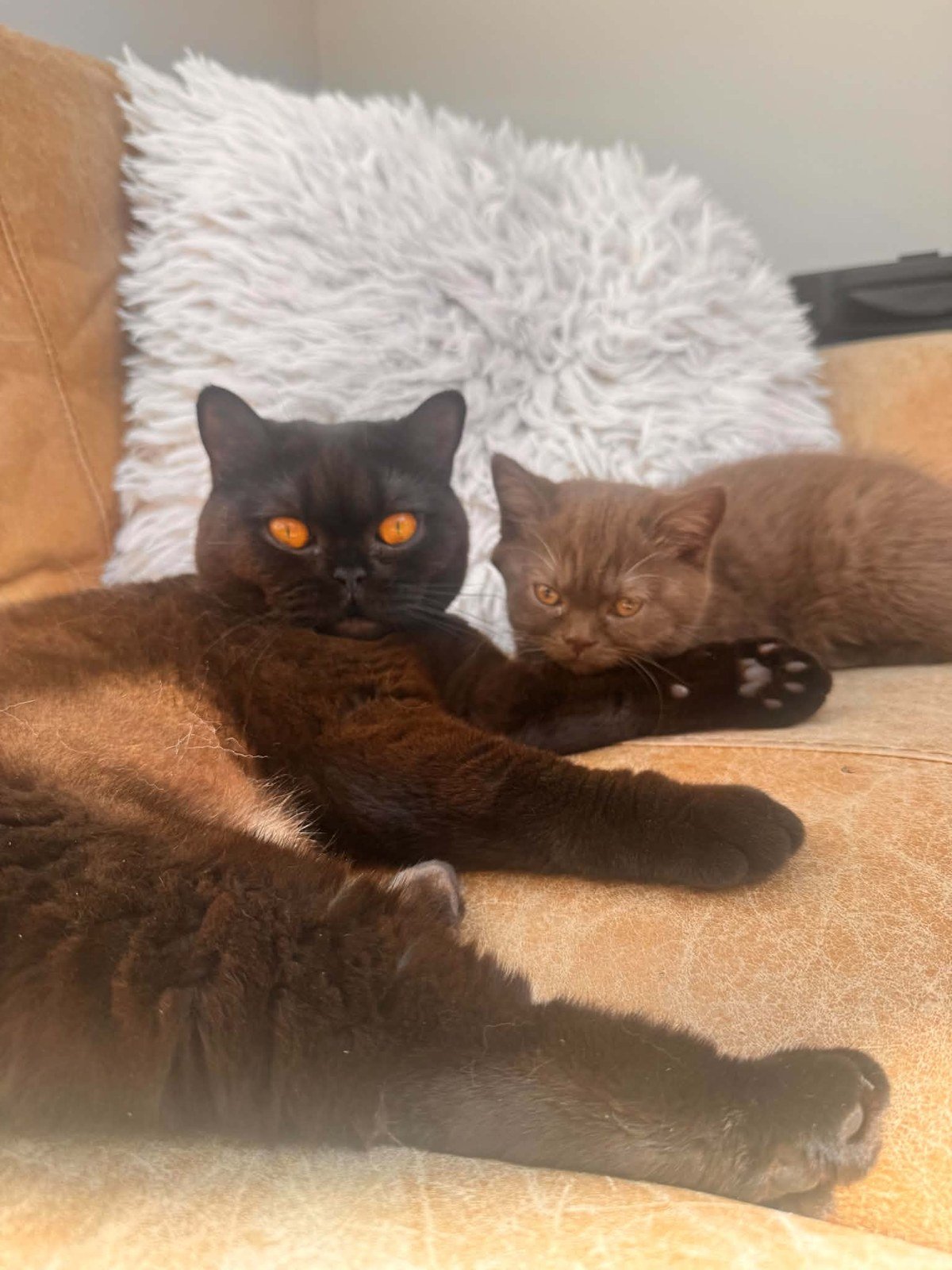
Rosie does more of the teaching than we do. She breaks up the games that have gone too far, and she is the one who takes them to the tray. I have never once had to show a British Shorthair kitten where the litter tray is. I suspect that is entirely her doing.
The vaccination maths that settles it on its own
Even if none of the behaviour mattered, the injections would decide it.
A kitten primary course is two vaccinations several weeks apart, and the kitten is not protected on the day of the second one. Immunity takes another week or two to build after that. Start at nine weeks and do the arithmetic, and you land somewhere the far side of thirteen before the kitten is genuinely covered.
An eight-week kitten leaving home has had one injection at best. Usually none. It is going into a car, past a vet waiting room, into a house with a different set of bacteria, to be met by a family who have quite reasonably been stroking other people cats all week. That is a lot of exposure to hand a kitten with no cover on board.
Our rule is written down and we do not bend it. A kitten goes home once its full primary course is complete and it has had around three more weeks to settle afterwards, whichever falls later. In practice that means fourteen to sixteen weeks.
It costs me money to keep them, and that is rather the point
I want to be straight about the incentive, because it is what makes the rest of this believable.
Every extra week is more Royal Canin, another sack of litter, more trays to wash, and another week before the balance is paid. Six extra weeks across a litter is not a rounding error. If I were optimising for money I would hand kittens over at thirteen weeks on the dot and have the next advert up the same evening.
Cats here are a hobby we love rather than a business, so nothing gets hurried. That line has been on my Siamese site for years and it is still the truest sentence I have written about how we do this. The practical version of it is that the kitten leaves when the kitten is ready, and we absorb the difference.
The things that only show up late
Here is the argument I did not expect to be making when I started, and it is the one that convinces most people.
You cannot see everything in an eight-week kitten. Some things declare themselves late.
I once held a kitten back rather than sell it, because I was certain it was a boy with an undescended testicle and I was not letting a family find out about an invasive neuter after they had paid. At thirteen weeks I finally worked out what was going on. She was a girl. The whole embarrassing story is on our About page, and the point of it is not that I am unobservant, although the evidence there is fairly strong. The point is that thirteen weeks told me something eight weeks had not.
Temperament is the same. At eight weeks a litter is a pile. By fourteen they are three separate cats, and I can tell you which one will settle next to you on the sofa and which one will be watching the room from the top of the wardrobe. That is how we match a kitten to a family, and it cannot be done six weeks early.
Thirteen weeks is a floor, not a target
Worth saying plainly, because a fair number of breeders quote the GCCF minimum as though it were a delivery date.
Thirteen weeks is the earliest it is permitted. It is not the recommended age and it is not what we do. If somebody tells you the GCCF says thirteen weeks as an argument for handing you a kitten at thirteen weeks, they have quoted you the floor and called it the standard.
What to ask a breeder who says eight weeks
Not confrontationally. You are gathering information, and the answers will tell you a great deal.
- Which vaccinations has the kitten had, and on what dates? Ask to see the card. One injection, or none, means the kitten is not covered.
- Is the litter registered with the GCCF? If it is, and the kitten is leaving at eight weeks, the breeder is breaking a rule they signed up to. Ask why.
- When did the kittens start weaning? An eight-week kitten is often only just off its mother.
- Can I see the kitten with its mother and its littermates? Not strictly about age at all, but it is the most useful question on this list.
A breeder who is comfortable with all four will answer them without breaking stride. That is really what you are testing. There is more on reading those answers in my guide to spotting a responsible British Shorthair breeder, and a wider view of the buying process on our British Shorthair buying guide.
Free download — no sign-up needed
If you are working through breeders at the moment, our kitten buyer checklist has the questions worth asking, in the order worth asking them.
More free guides: Diet & Feeding Sheet · Weight & Growth Tracker
What the wait buys you on collection day
The trade for waiting is a kitten that arrives already assembled.
Yours comes home fully vaccinated, vet-checked twice, microchipped at home by Paula rather than by a stranger on an already overwhelming day, wormed, flea treated, litter trained, and thoroughly used to a house with a hoover, a doorbell, grandchildren and a great many other cats in it. There are four weeks free Petplan cover starting the day it leaves, and a bag with the same food and the same litter it has always used, plus a blanket that smells of home.
Kittens are £1,200 with a £300 deposit. They go on the GCCF non-active register unless we have agreed otherwise in advance, indoor-only is a condition of the contract, and collection is in person from us in Fareham. The full list of what is in the bag and why is on our kitten information page.
What the extra six weeks buys you is not a bigger kitten. It is a kitten that has already done its growing up somewhere safe.
Frequently asked questions
Is thirteen weeks a legal requirement?
It is a GCCF rule rather than something I would rely on the law to enforce for you. Every breeder who registers a litter with the GCCF agrees to it. Check the breeder registration and the vaccination card rather than assuming somebody else has checked for you.
Will my kitten bond with me less if it comes home at fifteen weeks?
No, and this is the worry I hear most often. Cats are not ducklings. A well-socialised fifteen-week kitten that has grown up underfoot in a busy house will attach to you within days, and it will do it more confidently than an eight-week kitten that spent its first fortnight with you frightened.
Do you charge more because the kittens stay longer?
No. The price is £1,200 whether a kitten goes at fourteen weeks or seventeen. The extra weeks are ours to pay for.
What if I need the kitten by a particular date?
Tell us early and we will be honest about whether it is likely. We will not move a collection date to suit a holiday or a birthday, and any breeder who will is telling you something about their priorities.
Can I visit while I wait?
Yes, and we would encourage it. Once the kittens are old enough for visitors, come and meet them. The wait is a great deal easier when you have already had one on your lap.
Is a kitten harder to litter train if it comes home later?
Easier. It arrives already trained, on the litter it is used to, which is why we send you home with a bag of the same stuff. Changing the litter is one of the commonest reasons a settled kitten suddenly stops using the tray.