
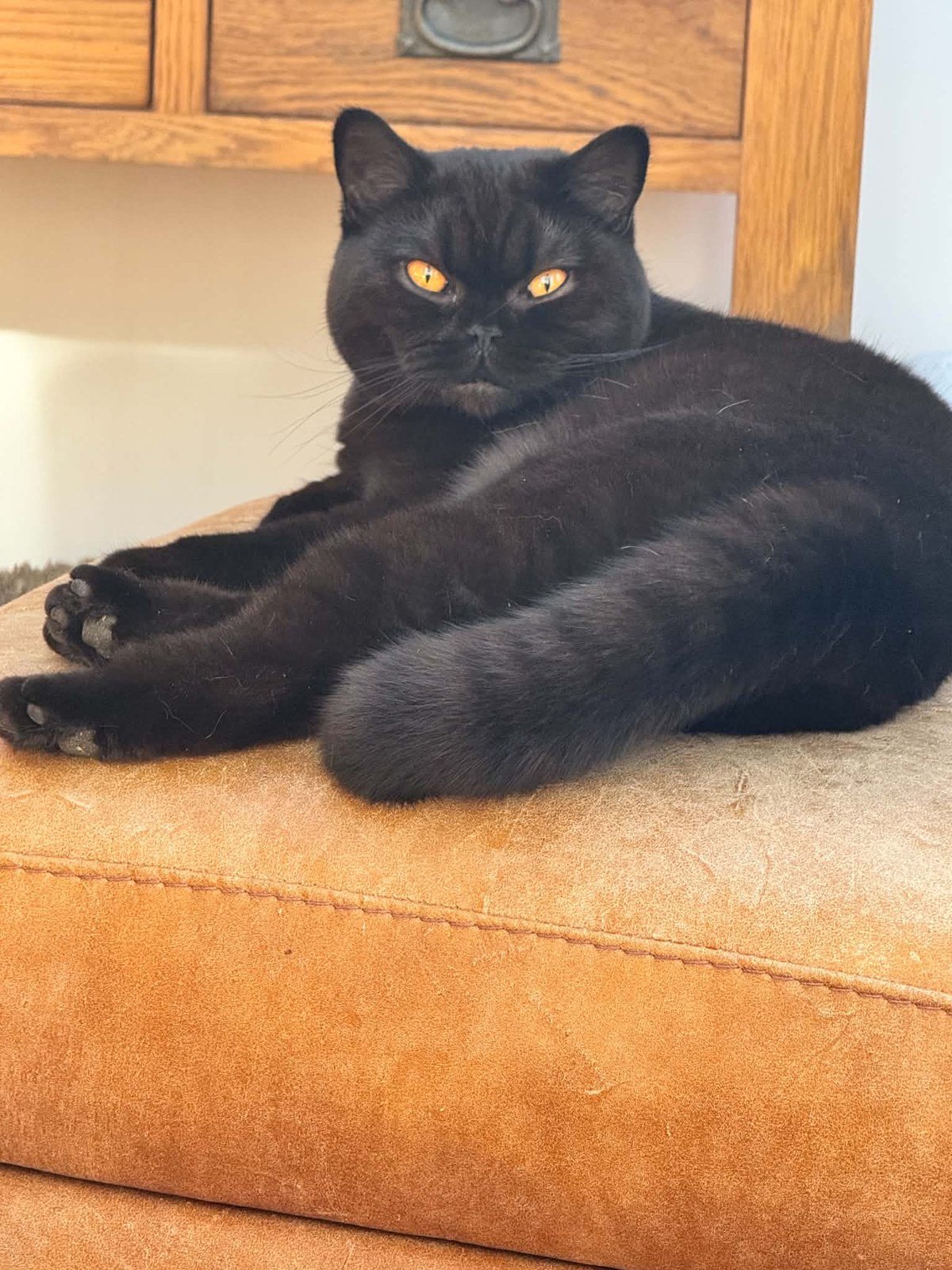
I judge British Shorthairs at GCCF shows, and I live with them at home alongside our Siamese and Orientals. Those are two very different views of the same breed, and both of them point the same way: if you want a cat that fits into a busy family without making a fuss about it, this is the one.
Here is what actually makes them good family cats, from someone who sees several hundred of them a year on the table and a handful of them on the sofa every night.
The temperament is the point, not the face
The teddy-bear looks get all the attention — the round face, the plush coat, the big copper eyes. But the reason families keep coming back to the breed is the character underneath.
A British Shorthair is steady. Undemanding. Quietly affectionate rather than clingy. They are perfectly happy in their own company for a few hours and genuinely pleased to see you when you get in, without treating your return as a personal emergency. That combination is rarer than it sounds.
It also shows on the show bench. When I have one on my judging table I want to see that placid, laid-back nature under a stranger’s hands, in a noisy hall, surrounded by other cats. A cat that handles like that is showing you exactly the character you will get at home. If you want the full picture of what a judge assesses, I have written that up in what a judge looks for in a British Shorthair on the show bench.
What it is actually like living with one
We share our house with British Shorthairs, Siamese and Orientals, and the contrast is instructive. Our Orientals will tell you at length about their day, follow you into the bathroom and supervise the cooking. Rosie, our black British Shorthair, will lie flat out on the leather pouffe with her paws stuck out in front of her and watch the whole performance without comment.
Neither is better. They are different jobs. If you want a cat that is involved in absolutely everything, our Siamese and Orientals at Burnthwaites are the breed to look at. If you want a cat that is present, affectionate and undramatic (a cat you can leave for a working day without guilt) a British Shorthair is the better fit.
They are also heavy. That is worth knowing. A mature British Shorthair male is a substantial animal, and most of them would rather sit beside you than be picked up and carried about. People who want a cat that will be scooped up and cuddled on demand are sometimes surprised by that.
Children and dogs
This is where the breed really earns its reputation. British Shorthairs are patient and tolerant, and their instinct when something gets too much is to walk away rather than lash out. That is exactly what you want around children who are still learning how to handle a cat.
Our kittens are born and raised in the middle of the house, not in a pen, so they grow up with the hoover, the doorbell, visitors coming and going. By the time they leave us they have already decided that people are a good thing and that noise is nothing to worry about. That does more for a kitten’s confidence in a family home than any amount of breeding for looks.
For the wider picture on temperament across the breed rather than just our lines, the British Shorthair personality guide on The British Shorthair Cat (the breed site I write) goes into more depth.
When a British Shorthair is the wrong choice
I would rather say this now than have you find out later.
- If you want a lap cat on demand. Some are, most are not. They tend to choose the cushion next to you rather than the lap itself.
- If you cannot live with moulting. That dense double coat drops hair, particularly in spring. A weekly comb keeps it civilised, but it does not stop.
- If you want a cat that greets strangers. They are polite rather than sociable with visitors. The Siamese will be in the middle of your dinner party; the British Shorthair will be watching from the stairs.
- If the cat will be free roaming. Ours go to indoor homes only, and it is a condition of our contract. They are trusting and not road-wise. A secure garden or a catio is welcome; the open road is not.
None of that is a criticism of the breed. It is just the difference between the cat people imagine and the cat that actually turns up.
The colours, briefly
Most people arrive wanting a British Blue, and the classic blue is still the best known. But the breed comes in a long list of colours and patterns — black, white, cream, chocolate, lilac, the colourpoints, tabbies, tortoiseshells, and the rarer cinnamon, fawn and golden. Rosie is black; her 2026 litter, sired by a cinnamon boy carrying dilute, gave us chocolates.
Colour makes no difference at all to temperament. Choose the kitten, not the colour. If you want to see the full range, the British Shorthair colours guide covers every recognised variety with its eye colour and standard.
What to expect from a British Shorthair kitten
They are slow to mature. A British Shorthair is not fully grown until around three years old, and the males keep filling out in the head and cheeks well past their second birthday. The gawky teenage stage is normal and it passes.
As kittens they play hard and then sleep like the dead. They are not, on the whole, climbers. They are built low and solid, and you are more likely to find one asleep in a cardboard box than on top of the wardrobe. They take to a litter tray easily and settle into a routine quickly, which is one of the reasons they suit family life so well.
For the practical side of the first few weeks (kit, feeding and settling in) there are plenty of owner guides on CattyLicious, the cat care site I write with Paula.
So, is it the right cat for your family?
If you want a calm, affectionate, undemanding cat that copes well with children, tolerates a sensible dog, does not mind being left while you work, and asks very little of you beyond food and a warm spot, then yes. It is hard to think of a breed that does that job better.
If you want a cat that talks back, follows you room to room and demands to be part of everything, look at the Siamese instead. I breed those too, and I would rather point you at the right breed than sell you the wrong one.
If any of that gave you pause, good. It was meant to. A British Shorthair is not a lap cat on demand, it moults, and it will not trail round the house asking to be entertained. If that is the cat you actually wanted, a Siamese would suit you far better, and I would tell you so on the phone rather than sell you the wrong breed. If it still sounds like your sort of cat, come and meet ours, or see who is available.
Free download — no sign-up needed
If you are still weighing the breed up, our kitten buyer checklist covers what to look for and what to ask before you commit. Free, no sign-up.
More free guides: Diet & Feeding Sheet · Weight & Growth Tracker
Frequently asked questions
Do British Shorthairs like being picked up?
Mostly not on demand, and I would rather tell you that now than have you disappointed later. They are affectionate on their own terms — a cat that comes and sits beside you and stays there, rather than one that wants carrying about. Children who want a cat to cuddle like a toy will find them frustrating. Children who want a cat that puts up with a busy household will be very well served.
How much do they moult?
A great deal, and twice a year rather more than that. The coat is dense and it comes out in handfuls in spring and autumn. A comb once a week keeps it manageable and keeps it off the sofa. Grooming is the job I keep for myself here, because it is the best twenty minutes of the day with a cat.
Can I leave one alone while I am at work?
They cope with a normal working day better than most breeds, which is one of the honest reasons they suit families. Undemanding is not the same as indifferent, though. If the house is empty for long days every day, two cats is a kinder answer than one.
How big do they get?
Bigger than people expect, and heavier than they look. A grown male is a proper armful. They also mature slowly — a British Shorthair is still filling out at three, which is part of why the adults look so different from the kittens in the photographs.
Do they need to be indoor cats?
Ours do, and it is a condition of our contract rather than a suggestion. They are a placid, trusting, valuable-looking cat with no road sense to speak of, and that combination does not end well outdoors. A secure catio or a safe garden run is the compromise we use here.
Are they good with dogs?
Generally yes, with a sensible introduction and a dog that has met a cat before. Their unflappability is the thing that makes it work — they tend to stand their ground rather than bolt, which is what teaches a dog to leave them alone. The same slow method applies as for a resident cat: my guide to introducing a kitten to an older cat works for dogs too.